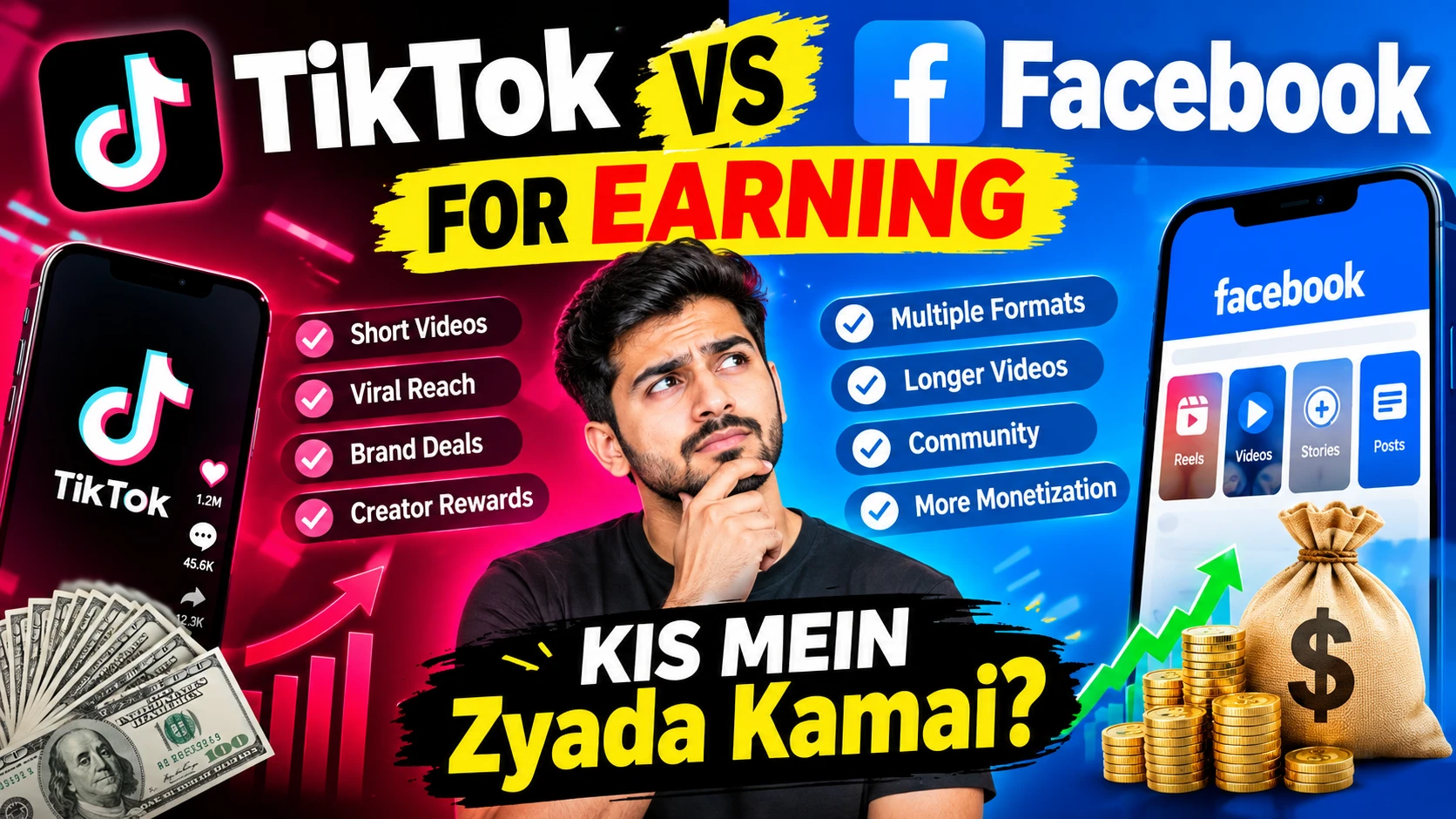
If you want to make money online through social media, one important question is: TikTok vs Facebook for earning — which platform is better?
Both platforms offer creators multiple ways to make money, including video monetization, brand partnerships, fan support, and other creator programs. However, the better platform depends on your content type, audience location, video length, engagement, and monetization eligibility.
In this guide, we compare TikTok vs Facebook earnings, monetization methods, audience value, earning potential, and which platform may be better for beginners.
TikTok vs Facebook for Earning: Quick Comparison
| Feature | TikTok | |
|---|---|---|
| Short-form video | Excellent | Excellent |
| Long-form video | Good | Excellent |
| Viral reach | Very strong | Strong |
| Multiple content formats | Moderate | Strong |
| Creator monetization | Creator Rewards and other tools | Facebook Content Monetization and other tools |
| Brand deals | Excellent | Excellent |
| Fan support | Available | Available |
| Best for | Viral short-form content | Diversified content |
| Earning potential | Depends heavily on eligible views and audience | Depends heavily on qualified views and content performance |
Winner for overall monetization flexibility: Facebook
Winner for viral short-form content: TikTok
But there is more to the story.
How Does TikTok Make Money for Creators?
TikTok has developed several monetization opportunities for creators. One of its major programs is the Creator Rewards Program, which replaced the old Creator Fund.
TikTok says the Creator Rewards Program focuses on original, high-quality videos that are at least one minute long. Its reward formula considers factors such as originality, play duration, search value, audience engagement, and advertising value.
This means that simply getting millions of views does not automatically guarantee a particular amount of money.
TikTok Creator Rewards
For eligible creators, TikTok’s Creator Rewards Program can provide direct rewards for qualifying content.
According to TikTok, eligibility includes requirements such as being 18 or older, having at least 10,000 followers, and receiving at least 100,000 video views during the previous 30 days, with availability depending on the creator’s region.
Other potential TikTok income sources include:
- Sponsored content
- Affiliate marketing
- LIVE-related monetization
- Selling products or services
- Brand partnerships
- Driving traffic to an external website or business
Therefore, TikTok earnings should not be judged only by its direct creator payout program.
How Does Facebook Make Money for Creators?
Facebook has a broader content ecosystem than TikTok. Creators can potentially monetize different types of content rather than relying only on short videos.
Meta’s Facebook Content Monetization program combines monetization opportunities across Reels, longer videos, photos, and text posts. Meta says creator payouts are performance-based.
In 2026, Meta reported that Facebook paid creators nearly $3 billion during 2025, its highest annual creator payout at that point. Meta also said that 60% of its total creator payout in 2025 went to Reels, with the remainder going to Stories, photos, and text posts.
This makes Facebook particularly interesting for creators who want to build several income streams.
Facebook Monetization Methods
Depending on eligibility and availability, Facebook creators can earn through:
- Facebook Content Monetization
- Reels
- Longer videos
- Stories
- Photos
- Text posts
- Stars and fan support
- Brand partnerships
- Affiliate marketing
- Selling products and services
Facebook has also been increasing its focus on original content. Meta says original creators can receive greater reach and monetization opportunities, while repetitive or unoriginal content can be deprioritized.
TikTok vs Facebook CPM: Which Pays More?
This is where many creators make a mistake.
There is no universal fixed CPM or RPM that every TikTok or Facebook creator receives.
Your actual earnings can vary based on:
- Audience country
- Advertiser demand
- Content niche
- Video format
- Watch time
- Qualified views
- Engagement
- Monetization program
- Seasonality
- Account eligibility
For example, an audience from countries with stronger advertising markets may generate considerably more advertising value than an audience concentrated in lower-CPM markets.
Therefore, instead of asking only “How much does TikTok pay for 1,000 views?”, creators should ask:
“How valuable are my qualified views and audience to advertisers?”
That is a much better way to evaluate earning potential.
Which Platform Has Higher CPC and CPM Niches?
If your goal is to build a high-CPC blog, website, or social media business, your niche can matter more than the platform itself.
Some commercially valuable niches include:
1. Personal Finance
Examples:
- Credit cards
- Personal loans
- Insurance
- Investing
- Banking
- Tax software
- Mortgages
Financial advertisers can have high customer acquisition values, which can make finance-related content commercially attractive.
2. Technology
Examples:
- SaaS software
- AI tools
- Cybersecurity
- Web hosting
- VPNs
- Business software
- Productivity tools
Technology can work particularly well with affiliate marketing because viewers may already have purchase intent.
3. Business and Entrepreneurship
Examples:
- Online business
- Digital marketing
- E-commerce
- Freelancing
- Business software
- Lead generation
These topics can attract advertisers selling relatively expensive products and services.
4. Education
Examples:
- Online courses
- Professional certifications
- Career development
- Programming
- Digital skills
- Language learning
Educational products can also provide opportunities beyond advertising, including affiliate commissions and course sales.
5. Real Estate
Real estate is another commercially valuable category because transactions and leads can be worth a significant amount.
However, competition is high, and creators should avoid making misleading financial or investment claims.
TikTok vs Facebook for Affiliate Marketing
If your primary goal is affiliate marketing, both platforms can work.
TikTok is powerful for:
- Product demonstrations
- Short reviews
- Tutorials
- Before-and-after content
- Viral product discovery
- Impulse purchases
Facebook can be powerful for:
- Product reviews
- Longer educational videos
- Groups and communities
- Reels
- Pages
- Retargeting and broader business ecosystems
The key is not simply getting views. You need viewers who are interested in the product and are willing to take action.
For example, 100,000 highly targeted views can potentially be more valuable than 1 million random views.
TikTok vs Facebook for Brand Deals
Brand sponsorships can potentially become a major source of income.
TikTok is especially strong for creators who produce engaging short-form videos and have a clearly defined audience.
Facebook can be attractive for creators with an established community, especially when they can combine Reels, longer videos, posts, and other content formats.
For brand deals, companies may consider:
- Followers
- Average views
- Engagement rate
- Audience demographics
- Audience location
- Niche
- Conversion ability
- Content quality
Therefore, a smaller creator in a valuable niche can sometimes be more commercially attractive than a large account with an unfocused audience.
TikTok vs Facebook: Which Is Better for Beginners?
Choose TikTok if:
- You enjoy short-form videos.
- You want to experiment with viral content.
- You can consistently produce engaging videos.
- Your niche works well with visual content.
- You want to build an audience quickly through discovery.
Choose Facebook if:
- You want multiple content formats.
- You want to publish Reels and longer videos.
- You already have an audience on Facebook.
- You want to build a community.
- You want to combine content monetization with other business models.
Can You Earn More by Using Both?
Yes. For many creators, the smartest strategy is not TikTok vs Facebook, but TikTok + Facebook.
You can create one original piece of content and adapt it for multiple platforms.
For example:
Step 1: Create an original 2–3 minute educational video.
Step 2: Publish the main version on Facebook.
Step 3: Create a shorter version for TikTok.
Step 4: Create additional clips from the same topic.
Step 5: Direct interested viewers toward your website, newsletter, product, affiliate offer, or service.
However, avoid simply copying other creators’ content. Both platforms are increasingly emphasizing original content. TikTok’s Creator Rewards requirements also specifically focus on original content, while Meta has stated that unoriginal content can lose recommendation and monetization opportunities.
How to Increase Your Social Media Earnings
If your goal is to maximize revenue rather than just views, focus on these strategies.
1. Target High-Value Audiences
Audience geography can have a major impact on advertising value.
Content that attracts viewers from markets with strong advertiser demand can potentially generate higher commercial value than content targeting only low-ad-spend markets.
2. Choose a Commercial Niche
Instead of making content about everything, build authority around a specific topic.
Good examples include:
- AI tools
- Personal finance
- Software
- Business
- Digital marketing
- Education
- Career development
- Real estate
3. Focus on Search Intent
Create videos answering questions people are actively searching for.
Examples:
- “Best AI tools for small business”
- “Best accounting software for freelancers”
- “How to start an online business”
- “Best credit card for beginners”
- “How to reduce business expenses”
This can attract an audience with stronger purchasing intent.
4. Build an Audience You Own
Social media platforms are excellent for discovery, but you should consider building assets outside the platform too.
For example:
TikTok/Facebook → Website → Email List → Product/Affiliate Offer
This reduces your dependence on a single platform’s algorithm.
TikTok vs Facebook for Earning: Final Verdict
So, which is better for earning: TikTok or Facebook?
The answer depends on your strategy.
TikTok is a strong choice for viral short-form content, discovery, creator growth, and brand opportunities.
Facebook is a strong choice for diversified monetization because creators can potentially earn from Reels, longer videos, Stories, photos, and text content.
If your main goal is maximum earning potential, don’t focus exclusively on the number of views. Focus on:
High-value niche + valuable audience + original content + qualified views + multiple revenue streams.
For many creators, the best strategy is to use TikTok for audience growth and discovery, Facebook for broader monetization, and a website or email list for long-term business income.